

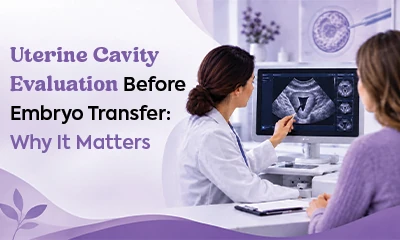
Uterus evaluation before embryo transfer is an important consideration when preparing for IVF. The embryo may be created successfully in the laboratory, but implantation takes place inside the uterus. Therefore, understanding the condition of the uterine cavity can be an important part of planning an embryo transfer.
Uterus assessment before IVF may help identify problems that are not always obvious from symptoms alone. Polyps, certain fibroids, adhesions and other changes inside the uterine cavity can sometimes be detected through imaging or hysteroscopy. When such findings are identified, the fertility specialist can determine whether they need to be treated before an embryo is transferred.
Embryo quality is not the only consideration
When people think about IVF, they often think about egg retrieval, fertilisation and embryo development. These are certainly important stages, but the process does not end when the embryo is created.
After embryo transfer, the embryo needs to interact with the lining of the uterus and implant. For this reason, the uterus is also considered during IVF planning.
This does not mean that every uterine abnormality prevents pregnancy. The effect depends on the type, size and location of the abnormality, along with other individual factors.
Conditions that may affect the uterine cavity
Several uterine conditions may be evaluated before embryo transfer.
- Uterine polyps
Polyps are small growths arising from the uterine lining. Some women may have no symptoms at all, while others may experience irregular bleeding.
When a polyp is located within the uterine cavity, the fertility specialist may evaluate whether removal would be appropriate before embryo transfer. - Fibroids
Fibroids are common benign growths in the uterus. Their impact on fertility varies considerably.
A fibroid that does not affect the uterine cavity may have a different significance from one that changes the shape of the cavity. Therefore, simply knowing that fibroids are present is not enough; their location and relationship with the uterine
cavity are important. - Adhesions
Scar tissue can sometimes develop inside the uterus following certain procedures, infections or other events. These adhesions can change the shape of the cavity.
When significant adhesions are present, the fertility specialist may recommend further evaluation and treatment before embryo transfer.
How do doctors evaluate the uterus?
There is no single test that is required for every IVF patient.
A transvaginal ultrasound is commonly used as part of fertility assessment. It provides information about the uterus, endometrium and ovaries.
Depending on the patient’s history and ultrasound findings, the doctor may recommend additional testing.
A saline sonography can help assess the inside of the uterine cavity by using saline and ultrasound to outline the cavity.
A hysteroscopy provides a direct view of the inside of the uterus using a thin camera. It can be particularly useful when there is suspicion of a cavity abnormality or when previous investigations have not provided enough information.
Why can hysteroscopy be useful?
One advantage of hysteroscopy is that it allows the doctor to directly see the uterine cavity rather than relying only on images from an external scan.
If a polyp, adhesion or another abnormality is identified, the fertility specialist can decide whether treatment is required. In selected cases, treatment can be performed during hysteroscopy itself.
However, hysteroscopy is not automatically required for every person undergoing IVF. The decision should be based on individual clinical circumstances.
What if your previous IVF cycle failed?
An unsuccessful embryo transfer can be emotionally difficult, and patients often want to know why implantation did not occur.
There can be many possible reasons for an unsuccessful transfer, and one failed cycle does not automatically mean that there is a uterine problem.
However, depending on the circumstances, the fertility specialist may review then uterine cavity along with other factors such as embryo quality, age, endometrial development and the overall IVF cycle.
A detailed evaluation can help determine whether there is an identifiable issue that needs attention before another transfer.
Preparing the uterus does not guarantee implantation
It is important to have realistic expectations.
Evaluating and treating a uterine abnormality, when appropriate, does not guarantee that an embryo will implant. IVF outcomes are influenced by multiplenfactors.
The purpose of evaluating the uterus is to identify structural or cavity-related problems that may be relevant to the treatment plan and address them when medically appropriate.
Your IVF plan should be individualised
There is no single checklist that applies identically to every IVF patient. Some patients may need only routine ultrasound assessment, while others may require more detailed evaluation based on their history or findings.
Your fertility specialist can determine which investigations are appropriate for you.
At Kiran Infertility Center, Chennai, the focus is on evaluating the individual factors that may influence your fertility treatment and planning the next steps accordingly.


Recent Comments